
Fake Chocolate, Real Exploitation
Updated: Mar 26
Why the World Keeps Cheating Afrika’s Cocoa Farmers
By Dr. Ibis Fro | De’ Calabash
A Quiet Theft Hidden in Plain Sight
There is a quiet kind of theft happening every day, and most people don’t even notice it. At the same time, a shift is beginning. Ghana, one of the world’s largest cocoa producers, has announced that it will move away from exporting raw cocoa and instead prioritize local processing and value creation within its own borders. This decision signals a challenge to a long-standing system where Afrika supplies the raw material while others capture the wealth.
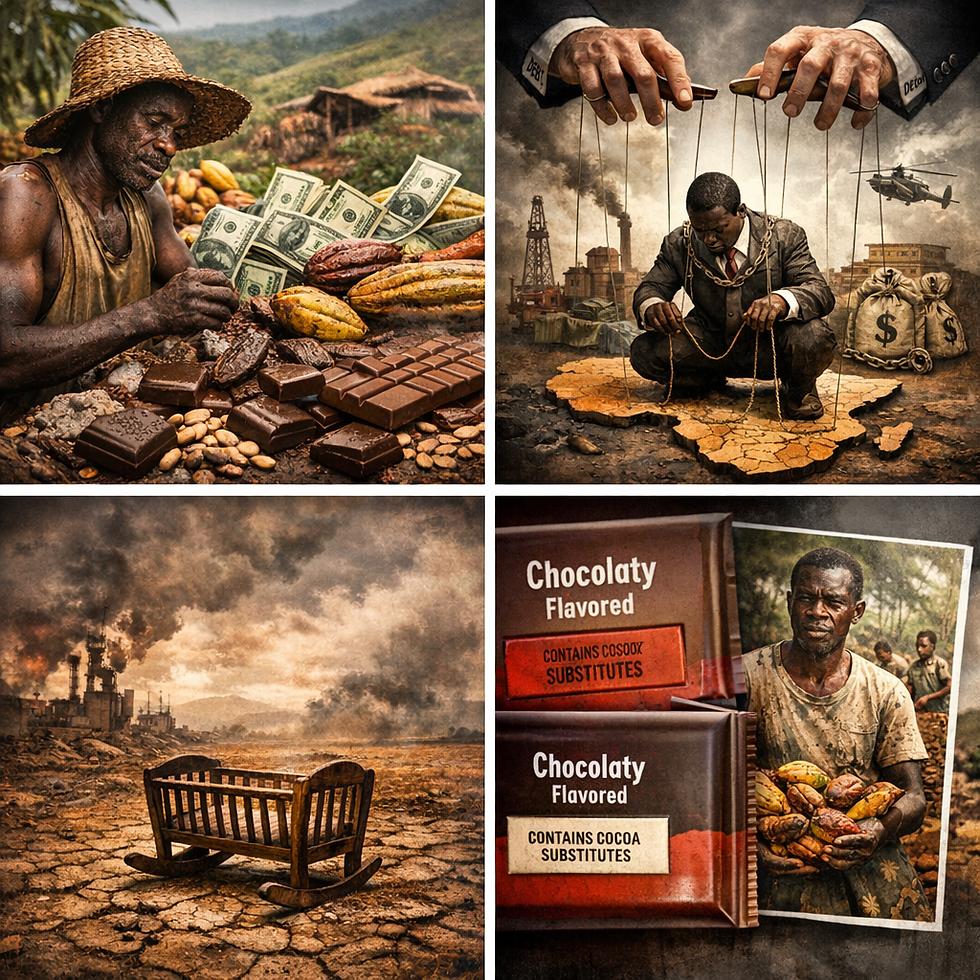
The global chocolate industry is worth over $130 billion, yet many companies are using less real cocoa and more cheap substitutes. Instead of paying fair prices to farmers in countries like Ghana and Côte d’Ivoire, who produce over 60% of the world’s cocoa, corporations are quietly changing the recipe. They replace cocoa butter with vegetable fats, reduce cocoa content, and increase fillers. What consumers receive still looks like chocolate, but it is increasingly disconnected from the people, land, and labor that make chocolate possible.
The Economics of Avoidance, Not Innovation
This is not innovation; it is avoidance.
When cocoa prices rise, instead of paying farmers more, corporations engineer ways to use less cocoa. They design around Afrika rather than invest in it.
This has consequences:
• Farmer incomes are suppressed
• Global profits remain concentrated outside Afrika
• Afrikan nations remain locked in raw export dependency
The world wants chocolate, but not the responsibility that comes with paying Afrikan producers fairly.

The Myth of a “Soft Era”
We cannot be in a so-called soft era of comfort, aesthetics, and surface-level healing without understanding the price of systemic theft and ongoing dehumanization. What we are witnessing is not accidental. It is adaptive. Extraction has not ended. It has evolved.

How Extraction Reinvents Itself
It morphs through:
• Supply chain manipulation
• Product substitution
• Trade structures that favor external control
• Financial systems that discipline sovereignty
All of it sustains a global façade of supremacy that normalizes Western accumulation at the expense of Afrikan futures.
Why Global Votes on Slavery Still Matter

This is why international decisions, like those at the United Nations General Assembly condemning slavery, are not symbolic. They are diagnostic. When nations abstain, they are not neutral. They are signaling a refusal to be held accountable.
The Language Has Changed - The System Has Not
Because accountability would require confronting the truth:
That many modern systems, rebranded as:
• “trade agreements.”
• “sanctions.”
• “development loans.”
• “stabilization efforts.”
function as continuations of the same logic that built chattel slavery.
The names have changed. The extraction has not.
Modern Forms of the Same Violence
What once was called slavery now appears as:
• Neocolonialism
• Economic coercion
• Political interference and coups
• Resource confiscation
But at its core, it remains the same:
Theft. Extraction. Control.
A War on the Future Before Birth
This is not just about present exploitation.
It is about preemptive theft.
Systems are structured to undermine Afrikan sovereignty before the next generation is even born, to extract value, limit opportunity, and define futures externally.
This is not accidental inefficiency. It is an intentional design.

A System Working Exactly as Intended
A system that:• Captures resources early• Controls markets externally• Prevents wealth accumulation internally
…is not broken.
It is functioning exactly as intended.

The Illusion of Chocolate
Consumers are often unaware that many products labeled as chocolate contain little real cocoa. Terms like “chocolatey” or “coated” mask the truth. This allows companies to:
• Maintain profits while reducing cocoa use
• Avoid fair sourcing commitments
• Market diluted products as premium
Meanwhile, the people who grow cocoa remain underpaid. They are still addicted to slave labor.
A Colonial Pattern in Modern Form
The pattern is consistent:
Extract from Afrika at low cost
Process and profit elsewhere
Replace Afrika when it becomes inconvenient
Now, the system has gone further, removing the need for Afrika in the product itself.

What Must Change
1. Afrikan Control of Production
Move from raw export to processing, branding, and ownership.
2. Collective Pricing Power
Set and enforce minimum cocoa prices across producing nations.
3. Transparent Labeling
Consumers must know what they are actually buying.
4. Structural Accountability
Global systems must be named for what they are, not rebranded for comfort.

The Bottom Line: This Is Not Trade - This Is Theft
You cannot claim to love chocolate while supporting systems that erase the people who produce it. And we cannot pretend to be in an era of softness while systems of extraction continue to harden against us. Because what is being taken is not just cocoa.
It is sovereignty. It is dignity. It is the birthright of generations not yet born.
And that is not trade. That is theft. They are experienced in this area, and we must work together to interrupt their pattern of unapologetic greed and normalized extraction.


Let Afrika and her children have the real chocolate.... they can keep the "ice cream" that doesn't melt